
Why Hands-on STEM Learning Beats Screen Time for Indian Kids

Ashray Sharma
Why Hands-on STEM Learning Beats Screen Time for Indian Kids
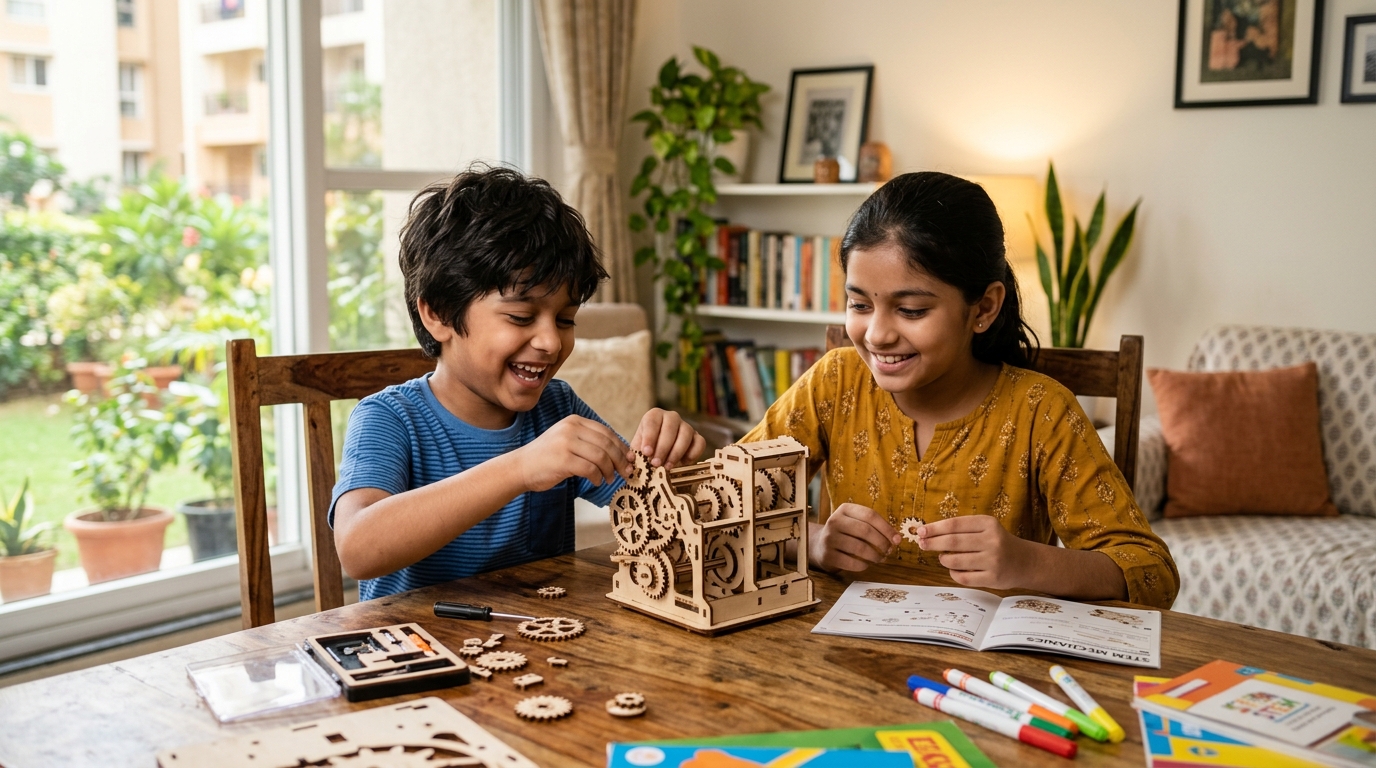
In an increasingly digital era, children across India are spending upwards of four to six hours every day interacting with flat touchscreens. While educational apps and videos offer visual information, pediatric neuroscientists and cognitive developmental experts agree: tactile, physical construction creates brain connections that two-dimensional glass screens simply cannot replicate.
The Neuroscience of Tactile Learning: Fine Motor to Brain Power
When a child picks up a wooden cog, examines the tooth pitch, feels the natural grain, and fits an axle with gentle friction, their brain is conducting complex calculations:
- 3D Depth Perception & Spatial Reasoning: The child must visualize how clockwise movement transfers to counter-clockwise rotation across gear trains.
- Proprioception & Fine Motor Control: Unlike tapping a tablet glass, fitting physical components demands calibrated pressure, finger dexterity, and bilateral coordination.
- Real Physics vs. Simulated Animations: Video simulations can cheat gravity or round off collisions. In the physical realm, if a track is misaligned by one millimeter, the marble stops. The child must diagnose, observe, and adapt.
Building Grit and Resilience: The Value of 'Productive Frustration'
One of the greatest dangers of modern digital games is the instant gratification loop—fail a level, click 'retry', and restart within three seconds. Real life and real engineering do not work this way.
When a young builder works through an InventoJoy kit, they encounter natural challenges. Maybe the gear binds because a washer was skipped, or a tower leans because the interlocking joint wasn't seated flush. Through this process, children learn:
- Root Cause Analysis: Asking "Where is the friction originating?" rather than abandoning the task.
- Patience and Delayed Gratification: Experiencing the profound, earned joy of turning the hand-crank and watching the entire mechanism spring to life after forty minutes of thoughtful assembly.
Screen-Free Action Plan for Modern Indian Families
Transitioning from screen dependency to hands-on exploration does not require throwing away all gadgets. It requires creating sacred, screen-free maker windows:
- The Weekend Tinkering Hour: Dedicate Sunday mornings to unboxing a building kit, spreading pieces on the dining table, and letting children lead the assembly.
- Ask Questions, Don’t Take Over: When your child encounters a stuck component, resist the urge to fix it for them. Ask: "What do you think is preventing this gear from turning smoothly? Let's trace it back."
- Celebrate the Prototype: Display completed models proudly in the living room or on study desks as tangible badges of curiosity and engineering grit.
Table of Contents
Related Articles
Screen-Free Parenting in India: 7 Practical Ways to Foster Deep Focus and Curiosity
Practical, proven strategies for modern Indian households to replace tablet doomscrolling with family tinkering sessions, hands-on maker toys, and real spatial creativity.
How Lenses, Cams, and Light Bring Stories to Life: The Magic of Vintage Projectors
Discover the optical physics behind moving pictures: persistence of vision, focal lengths, convex lenses, and Geneva drives inside mechanical film projectors.