
Building Architectural Thinking in Kids: From Wooden Castles to Structural Engineering

InventoJoy Architecture Team
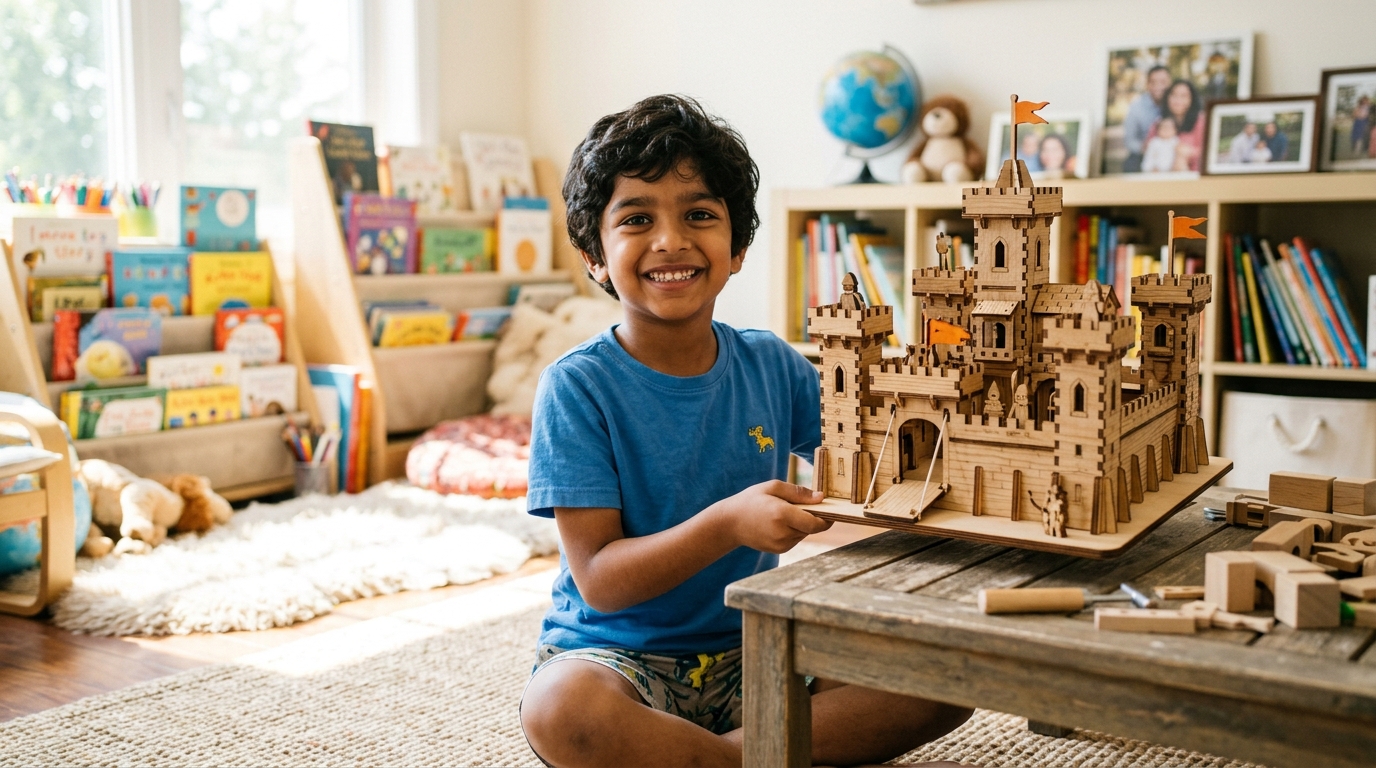
Building Architectural Thinking in Kids: From Wooden Castles to Structural Engineering
Civilizations are defined by their architecture—from the monolithic precision of the Konark Sun Temple to the towering cantilevered structures of modern Indian metros. Yet, architectural thinking begins in childhood, when a child first stacks blocks and wonders why a tall tower suddenly tips over.
What is Architectural Spatial Intelligence?
Architectural thinking is more than just building something that looks cool. It combines three key cognitive pillars:
- Structural Equilibrium: Understanding how gravitational load and compressive forces travel from the highest battlement down into the foundation.
- Spatial Modularization: Translating a flat, two-dimensional sheet of precision-cut interlocking Kapa Board into a three-dimensional standing structure.
- Proportional Symmetry: Balancing aesthetics, defensive fortification layouts, and functional spaces like drawbridges, gatehouses, and courtyard bastions.
The Science Behind Zero-Glue Interlocking Joints
InventoJoy's Construct Castle kit intentionally uses engineered friction-fit and mortise-and-tenon interlocking joints without messy chemical glues. Why?
- Reversible Problem-Solving: If a wall is accidentally placed in reverse, the child simply unslots the piece, inspects the orientation, and refits it.
- Material Integrity: Children learn how compressive tension between orthogonal pieces creates rigid, self-supporting structural walls.
- Fine Motor Confidence: Aligning multiple tabs across corner towers develops tactile sensitivity and hand-eye accuracy that pay dividends in mathematics, drawing, and future STEM careers.
Encouraging Spatial Thinking at Home
Encourage your child to analyze buildings in your neighborhood. Look at bridge trusses, window lintels, and arches. Ask them: "Where do you think the weight of that arch is pushing? How does the foundation hold it up?" When children build physical models with their hands, they stop looking at the world as passive consumers and start viewing it as architects and makers.